Wednesday, August 6, 2014

Introducing "The Book of Barkley"


      To those of you who have ever really loved a dog, this is a beautiful book.   It was beautifully penned by one of our readers who weaves so beautifully how a particular dog became a truly important part of her life, during its own twists and turns. The author herself is a remarkable woman.   This book is a lovely treat for yourself and a lovely gift to anyone who has ever loved a dog, and even for those who have not yet had that resounding and life changing pleasure.  I give this beautifully written book an unconditional recommendation.


The "Book of Barkley" in paperback

The "Book of Barkley" Kindle Edition


The "Book of Barkley" via  itunes


Other means will soon follow...


Barkley


Update:       This book has been recognized as one of the most promising Indie books of the season:

https://www.kirkusreviews.com/book-reviews/l-b-johnson/book-barkley/


Wednesday, July 16, 2014

Copperhead Snake Bites in Dogs


                       I often lament as to how hot it is in Summer in Virginia.  July can be a dangerous time outside for us and also for the animals.   A fair segment of our farm is forested,  and wooded areas and areas nearby these, come with their own hazards.   Over the last twenty-five years we have had a lot of problems in July when it gets very hot both on this farm and on previous properties.  In the nineteen-eighties, one July,  two of our young children were playing outside the house and were swarmed by bees that were apparently nesting under a railroad tie we used to demarcate our driveway.   An ambulance trip later, each child was treated at the hospital for between 10-20 stings each.  To this day, they carry epi-pens should they be allergic to an additional sting.   We have had several family members treated for Lyme Disease secondary to tick bites, also in July.   Three years ago, one of our young adult labrador retrievers was weak in the legs one morning and we saw the vet quickly enough to have Rocky Mountain Spotted Fever diagnosed.  The dog recovered fully following a full run of the appropriate antibiotic.  Ten years ago, in late July our beloved Albert, a golden labrador retriever was found dead with yellow jackets found on him.  The vet theorized that he died  of anaphylaxis following being swarmed by yellow jackets which are particularly aggressive when it's very hot.    I had checked him and changed his water not even an hour before we found him dead.   This past year our elderly Siberian Husky was successfully treated for Erlichia, also a tick borne illness. As much as I try to minimize the inherent hazards of these lands, they still exist.

                  Within the last couple of weeks I reported on my Rational Preparedness blog that a black snake was seen hanging from the rafters in our main barn.  I knew that wasn't a good omen, despite the fact that the snake itself is harmless..   This week, my eldest son killed two copperheads here on the farm, one large, and one smaller..  Normally, we ignore non-venomous snakes here.  We kill copperheads if they are within the area of the house or the animal barns. Normally, the black snakes keep the copperheads in check, if just by eating them.

                   We are also careful never to wear open toed shoes or sandals outdoors here.  In fact, anywhere near the forest, we wear boots.  You should consider doing the same in forested areas.

                  Early this morning (Sunday) I went out to take care of dogs before caring for horses, then alpacas, then sheep, and ultimately some of the other animals who are my charges.    We have a rather nice eight stall kennel for the dogs.  It has a concrete floor which is cool for the dogs, and each stall has a tall fenced area outside where they can play, dig and go to the bathroom.  There is also water and electricity inside.   From there, the dogs rotate to other areas of the farm to watch alpacas, keep an eye on ducks or chickens, or herd a lamb when necessary.  The dogs love to have a job, but they also like the mental stimulation of rotating to different places and having different jobs.  I also enjoy taking them out to a new place and collecting them at night to bring them back to the kennel.     Sometimes, when it's hot, most of the dogs, especially the older ones, just stay inside the kennel, content to drink the cool water in their buckets while listening to the radio while spread eagle on the concrete floor.

               Sometimes, in the morning, I start by checking the kennel, changing any water buckets that have hair or dirt in them, and leaving the others until later in the day when cooler water would be most appreciated.  Then we feed them.  While they eat, I check each outdoor kennel area and clean and straighten the exterior kennel enclosures.   This morning I noticed that Skye,  a border collie, had diarrhea.    I cleaned it up and looked at her.   She seemed fine.  I changed her water and fed her.  I made a mental note that her having diarrhea was unusual and I decided to check her again later.     At lunchtime, she seemed subdued, and she hadn't eaten anything.    Still, in the heat, dogs often leave food until later, especially the dry food, which this particular dog prefers.

                At four, when I often change the rest of the waters, move or return some dogs to the kennel, I noticed Skye was drooling.    I vinyl gloved and went in to investigate.    This time what was wrong became clearer.    Skye was drooling heavily and her normally thin mouth and muzzle were broadly swollen.
 My border collie now looked like a swollen pitbull !   Underneath the mouth and jaw, extending to the neck was extremely swollen and hard.   On one side of the jaw there was what looked like a puncture wound with a slight tear. Not far from it, was an additional wound. There was another similar wound nearby indicating that she may have been bitten a second or third time.  All the wounds were bleeding slightly.    I texted both my husband and eldest son, simply  "Kennel now".   They came and confirmed what I thought it was.   (I later read that on dogs, such bites can be very difficult to see, and severe swelling would be your first indication that something is wrong.  Because our dog fought, the bites are accompanied by slight tears which made the bites themselves bleed more, and therefore they became easier for us to detect.)

                Copperhead bites are one of the most common snakebites in dogs.   Copperheads are fairly aggressive, striking out early in the interaction with dogs (and human beings as well. )  Fortunately, adult specimens strike out and bite often without injecting too much venom.  Their strategy is to strike and repel the animal and then get away, keeping the rest of their venom for their prey. (Conversely, young or small copperheads may not yet know how to "ration" their venom and therefore they may envenomate using a much larger dose than a larger snake.) Consequently, most dogs survive a copperhead bite.   (Small dogs, elderly or sick dogs would be among the highest risk not to.)   Copperhead bites are extremely painful, and should receive veterinary attention. Pain, infection and loss of use can be real issues.  Skye's wounds, the degree and location of the swelling, her diarrhea and subdued demeanor are all well documented with copperhead bites, and we do know that this week, we have seen copperheads here.   We did not see evidence of neurological symptoms or of seizures, but these can happen also.  We theorize that the copperhead must have entered the kennel enclosure where Skye lives.  We saw no sign of it.  We are confident that since Skye is up to date on all immunizations, that nothing else is going on.

                Of course, it's four o'clock on a Sunday and the only vet who will trek out here on a Sunday night is an equine vet, who won't treat a dog.   I need to provide competent first aid and conservative treatment to my poor dog until the morning when the small animal vet can be reached and Skye can see her.    I have a number of good veterinary books and I verified some things online before moving ahead.   First, I gave liquid Benadryl in order to calm any allergic component of the reaction and help with burning and itching.  I had no injectable Benadryl (diphenhydramine) so I placed the child's liquid it in a feeding syringe and gently gave it in the side of her mouth on the side least swollen.  She took it, and swallowed, and drank water.    (Good, she will drink water !)    I have flunixin injectable for alpacas for pain and fever, and in an emergency I would use it for another species with the dosage adjusted for species and dog weight, but my research indicated that this drug even in therapeutic doses for dogs, this drug can cause ulcers in the dogs stomach and intestines and so it is not recommended. (I am willing to try many things, but I am not willing to do harm.)    Flunixin is therefore off the table for this.  Instead, I decided to liquify aspirin in a little bit of water and give her a dose for her weight, also using my feeding syringe.  Since copperhead venom can disrupt clotting, I will need to check carefully to make sure that the aspirin helps to relieve discomfort without causing excessive bleeding.   She took that also.   I tried to provide a soft treat but she wouldn't eat it.     Last, I have a broad spectrum injectable antibiotic (Tylosin)*** in date and approved for dogs.  I gave one intramuscular injection of the antibiotic which she barely noticed.  (The dose was appropriate for her weight.)   I repeated the dose the following day. This should be sufficient to help to decrease some of the swelling, manage the pain, and prevent infection, until a licensed vet can see her and treat this.  I also moved her to the "sick kennel" I use for the dogs which isolates anyone who is ill.  Meanwhile, my husband and eldest son searched Skye's normal kennel for a snake, with no luck.

                By seven pm she was not drooling, and was drinking a fair amount of water.   I have her some soft food which she promptly ate.   She remains significantly swollen but resting comfortably. Her pain seems to be managed.  By ten pm she was glad to see me and was appreciating the frequent visits with a tail that waved like a flag in July.    I gave additional Benadryl and aspirin in the middle of the night in order to help her to make it to the vets visit tomorrow.

               Very early this morning she remains very swollen.  I washed the areas that were bloody or drooly with cool water and she seemed to enjoy this.   I gave additional aspirin and Benadryl this morning.   Then she ate a bowl of soft food.  I kept her cool by giving her a "dog shower" gently outside.

                I would normally take a dog to the vet for what I consider an emergent issue.  We are a days drive from a veterinary critical care center, and I have dropped two to three thousand dollars there in the past for illnesses. I cannot afford to do that now without disrupting the ongoing care of all of the animals who reside here. So, since her pain is under control and her vital signs are quite good, she will have to be carefully cared for until I get get an ordinary vet appointment on a weekday.

                Within a day, almost all of the swelling and firmness in the muzzle was gone. She is eating, drinking, urinating and defecating normally.  I continued the Tylosin intramuscular injection for a total of three days, and I discontinued the aspirin after a day as there was bleeding from the the wounds even after a day.  I have been continuing Benadryl calculated to the dog dose for her weight every six hours while she is awake.   References indicate that we are not to apply ice, cut the region or try to suck out the venom on canines. We are also not to use  a tourniquet, even just after the incident.

               I still believe that a licensed veterinarian in the safest and best way to manage a canine snake injury.  I did want to provide this information to those on a preparedness forum in the event that in a genuine emergency your dog is bitten and you, like me, did not have the option of an emergency run to a vet.   Statistics indicate that more than 90% of dogs who are bitten by copperheads do survive, and that supportive care is important.  Dogs can be not only important family members but can be personal and animal protection on farms.   Rather than ending your dogs life, the plan of 1. Using Benadryl (Diphenhydramine) to address any allergic, burning or itching component of this injury and repeating it about every six hours   2. Providing short term broad spectrum antibiotics to avoid secondary infection.   3. Addressing pain with a dog appropriate preparation     All proved to be good strategies in an emergency.

              I have spoken to several farms locally and they all indicate that this year they have seen a larger than normal number of copperheads.  It may be that this year we have conditions which simply have favored this particular snake.  Watch carefully out there.

             We plan to follow up with the veterinarian this week.

This is a post of mine on another one of my blogs which shows the kennel building where the snakebite occurred overnight:

  http://rationalpreparedness.blogspot.com/2012/01/notes-on-building-kennel-or-kennel.html


 This is an excellent video


UPDATE:     By today, the following Friday morning, five full days from the snakebites themselves, all the swelling is gone.  Multiple puncture wounds remain with one which also has a slight tear.  These too are healing, but will need to continue to be monitored for infection.  She remains on soft dog food for the time being, and is urinating and defecating normally.   At this time, there appear to be no deficits.


ADDITIONAL UPDATE:    The University of Virginia says that it has treated 19 incidents of human copperhead bites this season.  This is a significant increase over the amount they would normally expect to see.  All the human beings treated there have survived.  They decline to speculate as to why there have been so many copperhead bites this year.
                                          
    Our dog has made an apparent complete recovery, three weeks from the initial multiple bites.


***  Important Note:   The injectable broad spectrum antibiotic Tylosin (Tylan) must NEVER be given to horses.  To do so. may well be fatal.     This drug is available in a couple of different strengths.  Pay close attention to the dose guidelines and the weight of the animal to which you need to administer it. It must be administered intramuscularly.   Whenever possible, consult with your farm vet before use. 

Tuesday, July 15, 2014

A Reprise: Steps to Avoid Heat Exhaustion in Animals and Pets

                     This post first appeared on my blog Rational Preparedness, at the beginning of July, in 2012.
  Since it's timely, I am reprising it here:


                         We have raised animals of different varieties in the Southern United States for twenty-five years, and there are some general rules which apply here, and in many if not most places.   The first is that all animals need access to clean water 24 hours a day 7 days a week.  This may sound obvious, but I do still occasionally see people who fill their pets water indoors only when they feed that pet, and the dish runs dry between feedings.  There are a number of devices, one can buy to ensure a continuous supply of water for your pet, even if you are away for a day or two.

This auto-waterer is for sale for about $24.00 US.   There are many other varieties inclduing one which uses a two liter soda borrle your provide and only has the base.   This can be used indoors, or even outdoors in a shaded region.


 The nicest thing about such containers is that although they are primarily intended for dogs and cats, they can be used for ferrets, chickens, ducks and many other types of animals particularly because these are sold in a variety of sizes. They are also fairly durable.


            For larger animals, I use a smaller durable bucket.     For alpacas I use a large plastic bucket for this purpose, and for dogs, I use a smaller one.

This is a flat back Fortex brand bucket which I use for alpacas waters. 

I use these smaller flat back buckets for dog waters.  These collect easily, fill quickly, and are easily cleaned.  One can carry multiple buckets when changing waters for many.  You would be surprised as to how much water even a medium sized dog can drink on a really hot day.


            Our vet says that sometimes, purchasing a large bag of ice and periodically adding some to dog water on really hot days can be a good idea.  She says that even an hour in really extreme heat can turn a dogs bucketed water into very hot water he will not drink.   She says the ice can make the water in the container drinkable for the dog longer than it would have been.

          I have a lot of inexpensive thermometers hung in our kennel and in a couple of hidden places where we rotate larger dogs on the farm as sentries.   These areas can get much hotter than you might otherwise believe.   You must make arrangements for even outdoor dogs who normally tolerate sun quite well, for shade in extreme weathers.


(  The plan for this particular run in can be purchased through horseloversstore.com  )


( This is their scaled down 8 x 12 version.  Plans can be purchased at  horseloversstore.com )


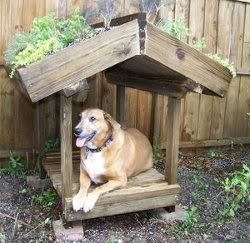
            The picture above is an artist's rendering of a horse run in.  We have a couple of these on the farm in outlying areas for alpacas.  This year, my husband built one, scaled down, for our large golden retriever male, Ben.    Ben's doghouse when he does sentry duty is way too hot for summer, but a scaled down run in, offers shade, and allows air circulation.     When it gets a little cooler, we plan to build an additional one for Skye, who also does outlying sentry duty.


This is another version of a hot weather dog house.  The overhang can be a good idea for a dog in hot weather.


The two pictures immediately above and below this label came from:http://www.toolcrib.com/blog/2009/10/24-free-dog-house-plans-peaked-roof-a-frames-dog-shelters-kennels-and-more


             If a dog is ever disoriented, in warm weather, then he needs to come indoors to a cooler location.  We keep one air conditioned room for supplies, and we have been known to allow an elderly dog to rest there, or in an indoor room in extreme heat.  Dogs also should not go for a run with you, if they are already headed for heat exhaustion.  Remember that animals develop heat exhaustion little by little usually over days, not just on one day.  Their dehydration is usually progressive over days.

            I do make sure that my alpacas have salt blocks in all weathers.   Vets tell us that dogs and cats do not require additional salt and that it can be toxic for them.

            I did learn something this week about chickens though.  Normally chickens receive plenty of salt from their food sources.  However, a breeder from Texas indicated to me that when temperatures reach 105-110 or 115 F that chickens benefit from having three things available to them as well as their normal rations.    One is plenty of cool water. Second is a small dish of lemon gatorade for energy and shock.   Third is a very small dish of water with two pinches of salt.  Apparently a little bit of salt in extreme weather can be beneficial to them.   We have not lost any additional chickens to heat exhaustion since we began doing this in very hot weather.  It is now our "extreme hot weather protocol for chickens".   We have not done this with ducks.


Sunday, June 8, 2014

About Rehoming.


They depend upon our making the best decisions for them.


                Let me preface this post by saying that I do understand that, on occasion, someone who really loves a pet has a legitimate reason for rehoming them.  Sometimes people develop allergies. Sometimes people need to fight a serious illness and their pet, a horse or something else, won't be receiving the standard of care that they need, while the owner needs to fight a potentially terminal illness.  Sometimes a family receives a financial blow which makes continuing  pet ownership difficult.   Once, many years ago, I rehomed a pet myself.   I knew a woman in the village I lived in then,  who absolutely adored my silky terrier, Ginger.   When we brought our first child home from the hospital, Ginger was so hurt, she wouldn't eat. I remember clearly that when I arrived home from the hospital with the baby,  I remember running the dog to the vet immediately while my husband took care of the baby.  Ginger really had been the center of attention, and was not sharing my time well. In the weeks which followed,  she didn't show great signs of adaptation to our new family constellation.  I truly loved Ginger and wanted her to have a chance at a continued happy life. I felt that by keeping her, I was letting her down.  I gave Ginger to the woman I knew who adored her so much, and  who had lost her own little dog to advanced age in the prior year. I made sure that the woman had adequate resources, and a good idea as to how to take care of Ginger, in addition to having a strong desire to have her.  (I would love to have a giraffe, but this does not mean I have the resources, housing, or veterinary care for her lined up !)  Ginger went home to a retired woman who was totally devoted to her.  Ginger had her own bedroom with a circular human sized bed !  Ginger traveled to Florida every Spring and stayed in a hotel. I am not sure what Ginger was fed, but I am betting it was fantastic.  My friend stayed in touch and Ginger seemed very happy with her whenever I saw them. I remember thinking that somehow I had done the right thing, even though I really missed Ginger.  When Ginger eventually died, the woman was devastated. She actually had a pet funeral and the dog has a genuine gray granite headstone at a pet cemetery. I am glad that I was able to find Ginger the type of home that she wanted.
             
                 However, rehoming a pet is not something we should do with any frequency or lightly.  Most pets are very attached to their owners. They will miss us if they don't see us every day, and if we disappear from their lives forever, they will wonder where we went, and often, they will grieve us.   It might also be negative for us to part with our pet.  Pets not only can be the reason for many people to continue to live or manage their own illness, but they help to reinforce a structure, when to get up, when to eat, when to walk or exercise etc.  Some people who part with their pets fall into an isolation or even a depression afterward.  So, from a pet and from a human standpoint, rehoming a pet can be a negative occurrence.    If you adopted your pet from the SPCA, normally you have signed a contract in which you have stated that if you find yourself in a position in which you can no longer keep your pet, that you are agreeing to return him to them.  If this applies to you, then find that contract and read it before doing anything else.


A lot of adult dogs make excellent pets


            In the last couple of years in the United States, the economy has not been good.  Many people have lost retirement accounts, homes, and jobs.  People who owned homes with back yards have lost them, and their large dogs have not been permitted to move with them into an apartment.  Many clustered housing units or apartments do not permit pets, or if they do, they might not permit anything but extremely small pets.   As a result of this, many pets are being rehomed, if not abandoned.

            The first thing I would like to encourage people to do, before taking on a pet, is to consider carefully if you can afford this animal in good times, and in bad.   Most pets aren't terribly expensive.  Most can eat a commercial cat or dog food which is readily available in large bags somewhere like Wal-Mart.  This is generally not too expensive.   Dogs who need a special diet, or some type of grain free may not necessarily cost a fortune.  Many feed stores have started selling a generic brand of some of the special corn free or grain free feeds for dogs with allergies, for example.  I have a large golden retriever who is on a special feed.  Veterinary care need not always be costly.  Most pets need some routine immunizations, and a rabies shot about every three years in most places is mandated by law.  In many places in the US, a heartworm preventive needs to be given.  When money is a problem, speak to your vet. There are generic forms of everything from the heartworm preventive to anti-seizure medications for dogs.  The vet won't know that you are having financial challenges and won't be working to find you lower cost alternatives, if you don't let them know you need help in this regard.   If your vet is the "vet to the very rich and famous" and won't do this, then you need to locate a real world vet. Believe me, they are out there.  Most of them don't make a fortune themselves, and finding ways to render excellent care without excessive cost is a hobby to many of them.


           Of course, there are occasions and pets who require very expensive care.  When this happens you need to consult with your vet, and you might need to try asking for some help with some verification provided, for assistance in funding such as kickstart or some other internet based fundraising site.  I do know several people who had their pets cancer treated absolutely successfully and received some assistance financially through internet based sites.  There was a single mom and boy recently on Craigslist who urged people to contact their vet online to verify their story, or the purpose of donating money for cancer treatment for their beloved dog.  A lot of people have helped, even if all they could donate was five dollars.

          If you find yourself in a temporary crisis, looking at moving with a dog then consider carefully how you might keep your dog.  It is possible to find a temporary caregiver to your dog and then take him as soon as you rent somewhere that is pet friendly following your move.  It is possible to have a relative care for him until you can collect him.   One of the best memories I have is having moved (in one of the hottest days one July) with two large dogs to the American South.   I drove the car with two babies in carseats while my husband drove a giant rented Ryder yellow truck with everything we owned in it, and the air conditioning on full belt for the dogs inside the cab with him.   It was more than 100 degrees fahrenheit on those several days, and the dogs, at least, had the time of their lives.  The dogs lived a full lifespan and only passed when the kids who had been in the carseats were in school.  Most pets are well worth the work we have to do in order to hold on to them.

         If you must rehome a pet, then the best situation is someone you really know.  This way, if something happens where they can no longer continue the task, you will once again be in the loop and be able to help. You also stand a better chance of finding a lifelong devotee to the animal, if you know the person well.  If you must procure a new person, then you need to meet them, and find out something about the home they plan to incorporate your pet into.  Do they have small children ?     Do they have other pets ?    What are their expectations of your pet.  Some pets can remain quietly at home while the breadwinner works, and other pets actually need doggie daycare !    Most importantly, you probably should charge a modest rehoming fee to immediately rule out people who want a free pet and probably can't afford normal veterinary care or pet supplies.  It would also be a good idea to include whatever food you are feeding, and the pet's bed, his food and water dish,  his collar and other articles which are special to him.  You should also include copies of his veterinary receipts with proof of his immunizations.  Keep the originals yourself in the event that the new home loses them or there is a fire.   It is also best if you stay open to talking to the new owners again.  If there is a problem, or even if there isn't. tell them you are open and willing to hear how they are doing.  You may actually make a friend yourself.

        When you can, and when it's possible, try to hold on to your pets, even through life's most difficult challenges.We really shouldn't take on a pet without making a lifetime commitment to them.   I can't say that I completely regret letting Ginger go to a new home, because she found a unique and devoted situation, however, I did miss her afterward and I often rethought over the years, whether I could have kept her.  My daughter who was the baby I brought home from the hospital before we ultimately rehomed Ginger, now has her own home, and a little dog, not unlike Ginger.  I often think of Ginger when I visit there.


Tuesday, May 20, 2014

Lots of Shots !


  When I was a young girl, no one I knew who had horses gave them any immunizations. I remember they had a farrier in now and again, but most didn't receive immunizations, and most didn't see a vet.  Most of us are doing a much better job of caring for our horses today.

                  In my region, there are a number of immunizations that should be administered, at least, annually. If you have a horse who has never been immunized, is ill, or you live in an area where certain mosquito borne illnesses are more common, then your vet may direct you to give certain immunizations to your horses every six months, or occasionally every three.  Some horses who travel or who are in the company of many other horses, such as in shows, may also have his immunizations increased as needed under the direction of an equine vet.


                   Even though I am a registered nurse and have given thousands of intramuscular, subcutaneous, intravenous, and intradermal injections to people over the years, animals are another matter.  I have been giving my dogs DHLPP injections under vets instructions for years. I have been giving my alpacas their immunizations and worming injections since the 1990s.  However, horses are entirely another matter.  Give a horse injection improperly and it may not work as desired. Administer it in the wrong place and you will do damage or traumatize the horse.  Approach the horse incorrectly and give the injection improperly and you may well be injured or killed by a spooked horse !     So, rather than learning to give an intramuscular injection on a horse from the internet, I had an equine vet demonstrate the location of the landmarks on a horse, and demonstrate and aid me with the best technique.  He also stayed to critique as I administered my first horse injection.   Done properly, the horse simply doesn't care.   However, great attention must be paid because even many injections later, a simple movement on the horses part, or even a little speediness or reticence on my own part, can make the injection more dangerous.

                  Although allergic reactions to immunizations which are common to many species are rare in horses, it does make sense to watch the horse for a few minutes after the injection.  It also makes sense to record where the injection was given.  For example, if I gave a combination immunization with Eastern, Western and Venezuelan encephalitis on the right side of the horse,  and I gave Potomac Horse Fever immunization on the left,  and now there is some swelling in the vicinity of the left, then it would be good to know that the horse may be sensitive to that particular immunization.


             In our region the immunizations most often recommended by equine veterinarians are:


    Eastern and Western and Venezuelan Equine Encephalitis

    Influenza and Pneumonitis

    Tetanus Vaccine

    West Nile Virus Vaccine

     Potomac Horse Fever   (Ehrlichia Risticci)

     Rabies  (which must be annual, not every three years as may be done with dogs and cats)


   Most of the time, horse owners buy immunizations which come in combination so as to decrease the number of injections the horse must receive.  Some injections are given by themselves.  Some injections must be given twice a few months apart before administering either every six months or annually.  The advice on an equine vet who knows what the "public health situation for horses" is in your area in invaluable.

Leptospirosis vaccine is not being recommended for horses in my region at this time.


           If fed properly, kept in a clean area, permitted adequate exercise and clean water and immunized regularly, most horses can attain 25-30 years of age or more.


Tuesday, April 8, 2014

Life With a Young Horse Named Shadow

             
Shadow, before I bought him, and had his hooves trimmed He is fitter and has much more of a mane today.


           Shadow is a two year old miniature black stallion who originated in Central Virginia.  His original owner became ill and could not keep him and so he was auctioned at a local livestock auction.  He was purchased along with other horses that day, by a mother and daughter who simply love horses and who committed to his rescue and to finding him a new home. They got to know him and wormed him before advertising him along with other individual horses.  I bought two of their horses, Shadow being the youngest of those. Initially, the veterinarian at the auction certified Shadow as a gelding, probably based on what he was told by the seller.

                Shadow and another small horse joined my other horses in the middle of last year.   Shadow is the youngest horse I have.  I took a couple of weeks to get to know him before having an equine vet examine him, and having his dental work (also known as tooth floating) done.   Then, I had the farrier come to work on his hooves.  I named him Shadow not just because he is true black like a shadow, but because he walks very near the other horses and appears to shadow them.

                 Of all my horses, Shadow is the instigator. He constantly teases, picks on, or annoys the older horses, and then runs off.  I have read that horses often create turmoil in an attempt to move up in terms of position within the herd.  As the smallest and the youngest, he is most certainly the bottom of the totem pole. He is not content to remain there.  The eldest horse, who is also the largest here, has been fairly tolerant of Shadow, the young whipper-snapper, but has had enough.   In order to calm the young upstart, the older larger horse grabs Shadow's halter with his teeth and in effect, times him out for 10 minutes at a time, or so. The older horse holds hyperactive Shadow in place until Shadow seems calm enough to be let go. Shadow takes the correction and remains still while having his halter held and sometimes even twisted, but this is never really effective for very long.  An hour or so later he is often back to annoying yet another horse.    The older horse does this several times a day now.   Our entire herd seems to accept and understand that Shadow is young, and that this excessive horse play is part of that. I am actually very lucky as occasionally a large horse will kick a smaller trouble-maker. Someone with whom we are acquainted had one of her horses fracture the jaw of another in just this way.

                Meanwhile, of the four or five equine vets who work for the group we use, the farrier, and a professional horsewoman who have been here in the last six months have all commented on Shadow. .  "Those are stallion behaviors" they have all noted.  " I bought him as a gelding", I kept saying.    I think however, that Shadow was either only partially gelded, or perhaps never gelded at all !   This would account for the bossiness and attempted periodic complete herd takeover !  The next time an equine vet is here, this will need to be a talking point.

               This morning I went out to take care of the horses, and I found that as a result of all the timing out by the oldest horse, that Shadow was missing his halter.   The halter lay in a muddy region of the pasture and is sadly cut beyond repair.   I bought a number of halters of different sizes when Jeffers Equine had a sale, and so I looked through my supplies for one that would fit him.   Of all the halters I bought on sale, none of them were as small as Shadow.  Eventually, I took the smallest one I had, that was marked as a small, and placed it on him.  I had to make a new hole for the buckle.  It still was larger than it should be, and so I decided I would probably need to buy even a smaller one.

                An hour later, the little stallion had  slipped his halter which lay, once again, in the only small muddy section of the pasture.  I also noted that by repeatedly pushing his stall door Shadow has damaged the latch to his stall.  This will need to be repaired.

                 Meanwhile, horses of this type are said not to be fully mature until about age seven.  I ordered a new halter online today.  Until it comes I can't turn him out on grasses beyond the pasture.