Sunday, July 31, 2016

A Tribute to Mr. Ditto Two

Ditto, as an older herdsire, after shearing, in his stall.

               Mr. Ditto Two came to us as a jet black young adult intended to be a herdsire. He came with a group of three to us from the Pacific Northwest in 1999.  We had purchased him in a small starter herd of three when alpacas were perhaps not so plentiful in the East.  When Ditto arrived, he came with one female, Noche Buena, and one gelding, Hot Reggae.  I remember as they disembarked from the air conditioned transport truck affectionately called the "alpaca train", there was a lot of distressed humming. Ditto countered with a lower and shorter hum, as if he were telling them that it would all be okay. I can't blame them for being concerned. They had left the green, wet pastures with more than a hundred alpacas and taken a more than three thousand mile trip to Virginia, a hilly, dryer and decidedly less green environment at that time of year. Also, at the time, their species was almost unique in these rural hills. We were the first alpaca breeders in our county.  Ditto had a nice and calm nature. He was generally cooperative for sheering, nail trimming and immunizations. All of our alpacas are loved, but Mr. Ditto II had a special place in the hearts of everyone.

               In the beginning we were told that alpacas live about fifteen years, but that a bit more time was possible in captivity with good care. Mr. Ditto II has lived a good life.   As our herd grew, he played soccer against half of them until the farm vet stopped the practice fearing that someone would break a leg.  He listened to Irish whistle and fiddle music as our children needed an audience.  He watched as a first barn was built on our first farm, and then he and his herd moved to a smaller temporary barn or run in, while our family built another farm and a much larger barn for his herd and his family.  Over the years, Mr. Ditto II sired a dark brown female Shakria, who died as an infant.  He sired Chocolat, a male who is at his side today, and a daughter with a jet black fleece like he once had, named Warrior Princess Camellia, or Cammie in these parts.   Mr. Ditto Two was a devoted male partner first to Queen Isabelle, the mother of his crias, who died from astrocytoma, and later to jet black Noche Buena.  Ditto's easy going nature never changed.

               Mr. Ditto Two is now twenty years old.  He was born on Valentine's Day just a few months before Daniel.  When many of us die, whether we are human beings or animals, our bodies simply wear out and can no longer continue to house our souls. Eventually, our souls must escape and go home.  This week, Mr. Ditto II's body is so well worn that he needs to sleep. Multiple systems are failing, even with good support and attention.  Sadly, with time our herd has returned to being a small one, and the herd sire does not wish to go, and to leave his remaining family without him.  He continues to fight to rally to remain, when he should simply just sleep. His herd takes turns cushing next to him in support.  It's strange that they know.  An apple horse gatorade bucket sits next to him and I lift his head every couple of hours for a sip, if just for comfort.   Every once in awhile he falls into a deep sleep and his respirations are shallow. Then he moves his legs as if running, as if he sees the green field in the next place and can't wait to run free once again. My husband and I turn him side to side on sheets laid on the concrete stall floor.  Part of us wants him to go so that he is spared any discomfort during these last hours, but part of us realizes that our children's childhoods and teen years were punctuated by the presence of this animal, and that his departure marks aging and a new era for our human family as well.

             You owe us nothing, Ditto.  It's time to go.  We will make sure that the remaining alpaca members of this farm family are cared for well.  Go home. Let Daniel and my father rejoice with you, as you will no longer be encumbered by your shell, as beautiful as that shell really was. Thank you for all the time spent with us.  You brought a lot of joy, and you deserve to be set free.


Ditto in his later years, when his black fleece turned gray.

                 Ditto passed quietly, at nine am this morning, with his son Chocolat cushed by his side, while I penned most of this post.   Hot Reggae who is also elderly and who has also been ill this week, seems to be moving well at the moment, and Ditto's daughter Cammie will receive extra attention today as well.


Sunday, July 3, 2016

The Short Life of "Peep"


This is a picture of a normal Rhode Island Red hatchling


On Thursday afternoon I went out to begin the afternoon care of the dogs and I heard a loud chirping like a bird. I thought that a mother bird teaching its fledglings to fly probably had a straggler who was calling for her. Still, the chirping did not let up, and it was of some urgency. So I took a break and went in the direction in which I heard the noise.  Then, I looked into the hen home with rooster nearest the dogs and I saw what looked like a hatchling duck flailing in their deep water dish.  "Help me, I'll drown !" was apparently the probable translation of the urgent chirping. The rooster in the pen and the four hens acted as if the chick were a predator.   When I scooped the little bird out of the water, I took her into the barn to dry her with a paper towel. Then I took a look at her in bright light.  She wasn't a duck at all. She was clearly a new hatchling from one of my hens in the pen in which she was found. She was a small Rhode Island Red, and she was quite a pretty one.  Domestic hens don't always know how to mother, and an accidental chick such as this one, would likely pass away, just as two did inside the hen house last year.    So, I took the little chick, found a small box, a jar cap for water, and a jar cap for food. It was quite warm and so a hatch light for warmth could wait until this evening.   She certainly was active and moving well.  I did notice when she was wet that she had a prominent crop.  Rather than food passing right to the stomach, as it does in mammals, chickens have something called a crop, which is a pre-stomach which houses food until it moves on to the fore-stomach.  Sometimes, food gets stuck in the crop and can cause problems, usually for adult chickens. I had never seen a chick with a prominent crop in her neck.  For a moment I considered that she may have a congenital anomaly, but this possibility did not change what I had to do. I had to take care of her as if she were any other chick. An anomaly, if it existed, would take her soon enough.

       I had quite an afternoon.  I didn't have a cage quite small enough and she kept exiting the cage by squeezing through the bars.  The barn cat Brielle would have been more than happy to eat her, but I looked at Brielle, and said, "No !" and Brielle flounced off as if to say, "You owe me a better treat than that, later."
Eventually, I placed the little chick in a box and moved her to the laundry room in the house.  That would be warm and bright, and safer.

       For a hatchling, she didn't seem to eat and drink as much as I remembered them to.  Still, for two to three days, they are hatched with enough nutrition to allow them to take those three days in order to learn to eat and drink.  I had lined her box with paper towels and there were stools, and so I thought she was doing well.  That evening, my husband found the hatch light so that the chick could be warm enough as the temperature would drop overnight, and chicks need a fair bit of warmth.   On Friday, she still didn't seem to eat or drink well.  Since hatchlings learn almost everything from other hatchlings, we decided to see if the feed store in the next county could sell us a couple of chicks. They had no chicks but they had a guinea of the same age, whose early developmental milestones are about the same, so we came home with a friend for our hatchling I had named Peep.   The guinea, whom I have called Skoot was much more active and much hungrier than Peep.  By evening, I thought Peep needed some rest and so I separated them in two boxes for the time being.

         This morning I checked on Peep at 5:30 am.   Despite the light and all the care she had been given she was clearly deteriorating.  When I examined her carefully, her vent wasn't closed shut (a reason that a hatchling might not want to eat and drink)  Her umbilical area was as expected.  However, her skin and wings seemed dehydrated to me. I mixed a drop of golden syrup in water with a grain or two of salt and proceeded to feed her with an eye dropper being careful to approach the side of the beak and not get liquid in the nostrils. She took some. There had been no stools overnight.  She seemed quite weak. She also seemed quite cold despite the fact that she'd had the benefit of the hatch light overnight.

            As I held the little bird, I realized that she had deteriorated overnight to a point at which I was unlikely to be able to save her. How sad to overcome such odds to be hatched, to avoid drowning, to call for another species to save you, just to succumb to some type of anomaly or difficulty just two days later. Poor Peep.  I hoped her passing would be as quick and as painless as it could be. It's Sunday, and I don't have a particular schedule this morning. I can feed the horses, alpacas and dogs a bit later, and so I held Peep in a gloved hand speaking to her, while holding her under the hatch light. I thanked her for calling me and giving me the chance to try to help her. I told her that she had fought hard to come here and to stay, but that sometimes the lessons God teaches here on Earth can be taught in a very short time. I told her I had a son and a father who could look out after her in the next place, if God allows them to, and I think he will.  Then she started to use accessory muscles for breathing and I didn't think it would be long. I held her with one hand and stroked her with one finger until her respirations became difficult to see.  Then she tried to jump out of my hand with energy I didn't know she still had. When I gathered her into a more comfortable position in my hand, I saw that she had died.

         Goodbye Peep, I will miss you, and I will take care of your friend Skoot.  Thank you for coming.


Update:   July 24, 2016       After Peeps death, we bought five more guinea keets to keep Skoot company. All of them are growing well and enjoying the summer.


Monday, June 20, 2016

An Old Hound

    
I always keep one of these in the car, along with some water and some dog treats.


  My husband has asked me, no begged me, not to take on any more rescues.  Currently, we can afford to care for the rescued horses, dogs, and poultry we have along with our alpacas.  However, my husband has been watching trends. The farm vet, the equine vets who will each come out to the house cost more than they did a couple of years ago.  The small animal vet, where we take the dogs has also increased their charges.  As I drove home Friday, I was pained to see a dog lying in the road about a mile from our farm on the curvy mountain road.  I stopped to see if she'd been hit.  I am fairly friendly with the farmer nearby. They also rescue animals on occasion, but wouldn't be doing so, this time. They had a new baby and with their other children, their hands were quite full. They had called the pound and they would be there sometime later in the day.  I knew that the local pound would euthanize her.  In the last year or so,in our area, rescue groups will collect purebreds, immunize them and then adopt them out for often a $500. fee.   Pitbulls, beagles, and hounds, which are common here. would not be so lucky, and would probably be euthanized in a week or so.
      
  I took a look at her and determined that she had not been hit. She had no collar and the pads on her feet were quite swollen. She was quite thin, even more thin than hunting dogs are supposed to be.  My neighbor the farmer said that at the end of each hunting season, some hunters simply remove the collar, release the elderly or ineffective animals to fend for themselves. They survive or they die.  This is a foolish and barbaric practice in a place where rabies is endemic, and wolves and coyotes are plentiful and run free.  My friend the farmer had fed and watered her earlier in the day.  I threw a disposable bed liner on the floor of the passenger side of my car and tried to coax her there. Most dogs listen to me. She allowed me to gently lift her into the car, and then she fell asleep.

         I thought my husband wound be angry when he arrived to find I had set up a dog house in the shade, some distance from my other dogs in order to quarantine them from her.  I thought we would take care of her immediate needs, pay for a vet visit or two and then locate a new home for her ourselves, no matter how long it took.  My husband was unusually sympathetic to this elderly female hound who seemed bewildered yet a bit more animated when he arrived. I took this to mean that she had been owned by a man.

          I fed her small amounts several times each day over the weekend.  I have placed the appropriate liquid dressing on the pads of her feet. Today, I will speak with the pound and ensure that no one is looking for a dog fitting this description. I will tell them I have her, and they might issue me some adoption papers and provide me a discount certificate for spaying.   I will also need to take her for a rabies shot and a heartworm test.  I will give her a distemper-hepatitis-leptospirosis-parainfluenza and parvovirus shot myself as I do the other animals in my kennel.  If she is heartworm negative, I will begin heartworm preventive.

           Once the dog was hydrated again, she could feel how sore her pads really were. She yelped when she had to stand to drink or to eat, or when I took her for a short walk to urinate or defecate.  She doesn't know how to walk on a leash. It's possible that as a hunting dog, that she never has.

           My husband has been fairly attentive to her. He made several stops over the weekend to check on her and make sure she was cool enough and comfortable, despite the fact that he knew I was visiting her on a particular schedule. He even made a trip to Wal-Mart to buy her, soft food of her very own.  I think this old girl is going to need a name. I don't think I am going to need to work very hard to locate a home for her. I think she has already found one.


Update:   July 24, 2016  "Miss Penny" has been seen by the vet, given a rabies shot, had a heartworm test and has begun monthly heartworm preventive.   She had no collar and has no microchip.  She will likely spend the rest of her days here on the farm under our care.


Friday, June 17, 2016

The Disappearance of Patch

          
Patch is up in front


      Patch is a large attractive Rhode Island Red rooster that is a son of Ross the rooster. Ross the rooster was purchased by our young son Daniel two days before his sudden passing in 2008.  Since Daniel is no longer here, all the animals Daniel cared about have become even more of a devotion than they were when he was here.  With Ross the rooster now gone eight years later, his progeny is now the point of our focus.   Patch is a large and attractive rooster who has a nasty habit of walking in messy or wet places.  This has resulted in a periodic infection of one foot which is called by farmers, bumblefoot.    The most correct treatment for genuine bumblefoot is a surgical removal of the swollen and infected area, and then a packing of the region until it heals from the bottom of the wound to the top, which is also known as healing by second intention.

              Most vets won't do this because it's a couple of hundred dollar procedure on an animal they believe is only worth twenty dollars. I would have paid for it to be done, but I found something which took care of it   I had given Patch a 0.4 cc injection with a tuberculin syringe subcutaneously of tylosin. The foot was resolving as the infected portion was in a process of coming to a head. I thought that I may have to repeat the injection, and that I may have to lance and wrap the foot. Patch was impaired by the foot not enough to be unable to fly out of his coop during the day, but he was impaired enough to limp around after the injection triggered a process of resolution. Patch was a fan of free ranging which is usually safely possible here at least during the day.
              Later that day I came out to check on animals and found a pile of beautiful red feathers where Patch normally sauntered.  Many times, a predator won't be able to take a singular rooster, especially during daylight. I looked over a broad area. I thought he may have been attacked, but that a predator likely couldn't have taken him   On the opposite side of the barn I found another collection of feathers, the type close to the birds skin.  We theorize that something grabbed Patch from the air and that as it went airborne, he fought. The second pile on the other side of the barn may be where the predator dropped him long enough to get a better grip. Although there was no blood, I believe he was killed there. There was nothing else anywhere.  I spent a couple of hours looking for him in the event that another predator had grabbed him and was wrestling him to their den.  I think the broad winged hawk is probably the predator in this case.  Patch, I am so sorry I did not contain you while your foot was healing so you would have been in top form when the predator assaulted you. I am glad, however, for all the free ranging you have done, quite safely for almost seven years. I know your passing was swift and that your parents and siblings will see you now.  Thanks for coming and enriching all of our lives.


Tuesday, January 5, 2016

Henriette


This is a picture of Henriette and her sisters, when they were younger.


  Here in Virginia we don't normally heat the structures that house chickens or ducks. We have had them here for more than ten years. The only time I use an incandescent light as a warming light is during hatching and in the immediate hatchling period.

        The breeds we have here tolerate even extreme cold, and will huddle together inside where it's dry in the rare event that it snows.  The lifespan of a Bantam hen is about seven to eight years, and that is right where these girls are. These are a cross between their Bantam mothers and Rhode Island Red sire. Still, when last evening I learned that it would be 13 degrees F overnight, I checked the housing. I wanted to make sure that everyone could find a clean, dry, place inside.  I was more concerned about some of the larger furrier dogs in the kennel than I was about the chickens.

        Life holds surprises. This morning, all the horses, elderly alpacas, ducks, cats and dogs emerged from their homes happily, but one of the hens did not.  It is unlikely that hypothermia got her. It is more likely that she had reached the end of her lifespan and was ill with something, usually respiratory. The cold weather certainly didn't help but was more likely to have been a catalyst rather than a causation. I will miss Henriette. All animals, no matter what type, are a blessing. Thanks for the eggs, the entertainment, and the loyalty. You will be missed, by your family and by your human family as well.


Wednesday, November 25, 2015

Recalling the Lucky Acquisition of Benjamin

This post first aired in June, 2013    on my blog "What I Learned from Daniel"

I am reprising it here as our acquisition of Benjamin occurred in Autumn, and because as Benjamin ages, this is a cherished memory.


Benjamin, at age nine, at 108 pounds of muscle.


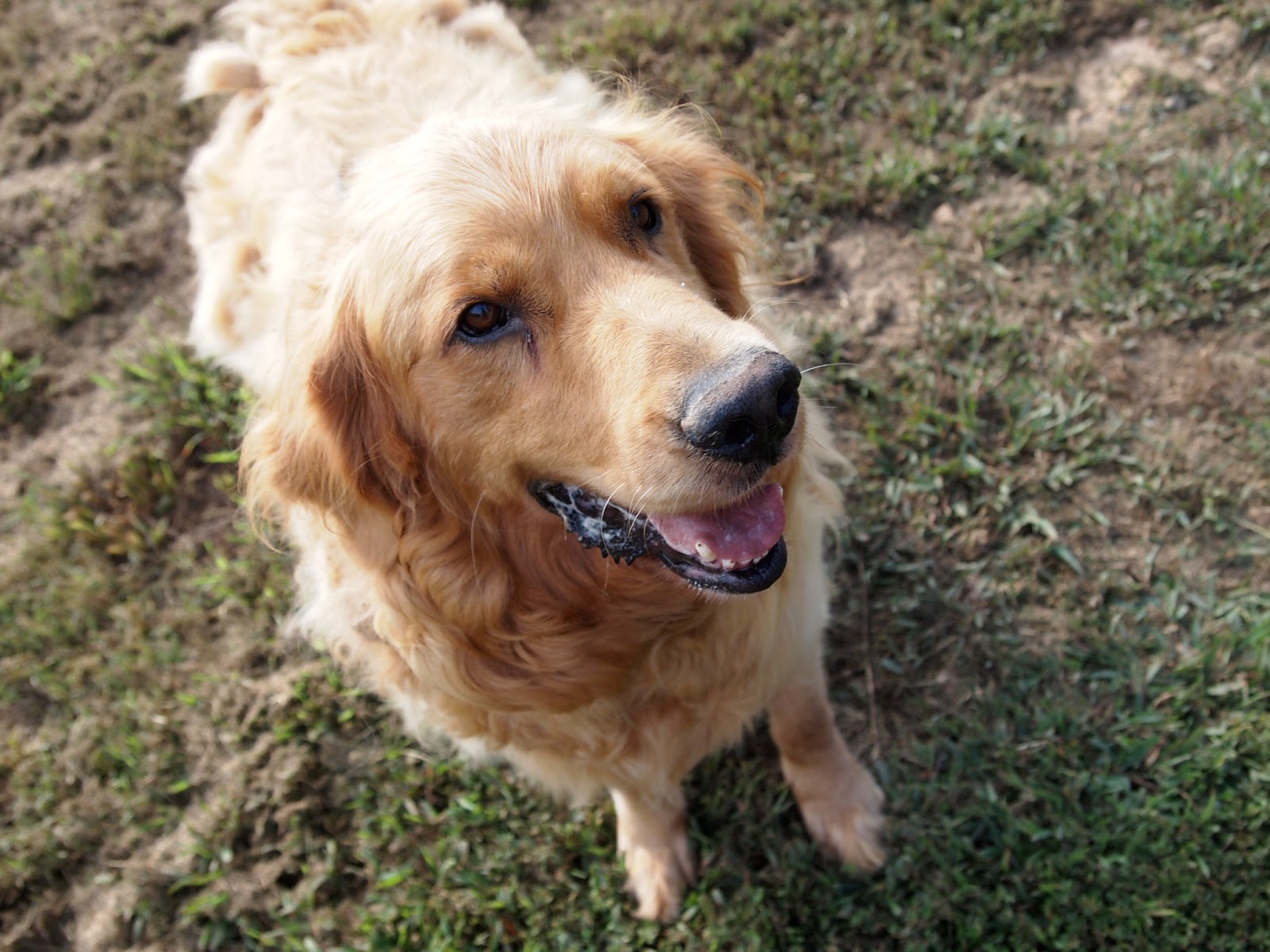
    In November of 2006, my beloved Susan, a golden retriever and cocker spaniel mix, passed away after a long fourteen year lifespan.   She was a beautiful girl and was very good with kids.  She was selected by our son Matthew when he was a very small boy, and Susan was six weeks or so.  She successfully fought breast cancer at age seven.  (Yes, dogs have mastectomies too.)   She was a lovely girl who looked just like a  scaled down golden retriever.  She was protective of the kids, and if she thought someone was a danger to me, her diminutive size did not prevent her letting the person know she would defend me.  I will miss her all of my remaining life.
            After Susan's passing, I instinctively knew that this would mark the beginning of a trail of losses, and in fact, it did portend a trail of losses.  I decided that although no animal ever really can replace another, that as a tribute to Susan, I would provide a home to an animal in need, similar to her breed if possible. In our area, absolutely no golden/cocker mixes needed homes, although I did find a woman who was deliberately breeding them, and charging a fortune for them.  On Petfinder, I eventually found a large male golden retriever who was in a pound in a city about two hours from here.  I headed up there to find that pet adoption was not at all a simple matter.  First, although he had been advertised, I needed to wait two weeks to allow his original owners to return to claim him.  It turned out that he was a frequent flyer there.  His owners lived in a small home with a small yard and this large male golden was forever being turned in to the pound by others, as he liked to wander. There was still the possibility that his owners would come to get him in the next couple of weeks.  So I visited him a couple of times, and waited for the day he would be deemed free for adoption.   Secondly, there was another problem.  He was a pedigreed dog who was non-neutered and the laws of that locality prohibited me from taking him unless he could be neutered and microchipped there, before I took him home.   Finally, we arranged for him to be neutered  there.  Lastly, the Perfinder ad had generated a buzz and no less than eleven people wanted this particular dog, despite the fairly high adoption fee.  I was told that they would release him to the person who was there earliest that morning.  They advised me to drive in that evening, and remain there all night in order to be the first.  Normally, I would have let the dog go to someone who lived nearer, but I knew that this dog needed large spaces, and that the suburbanites who lived close by probably couldn't keep him happy or contained.  The afternoon before he was available, I drove in, told them I was there, and that I was prepared to wait all night. I provided them with a letter stating the time I had arrived at the pound, as they had requested.  I got something to eat,  used the pound's bathroom, and sat in my car listening to the radio.   Despite all the bright lights outside the pound, I fell asleep in the reclining seat of my car, at about 10 pm.   I awoke with a start at around 2am.  A man with a van had driven up beside me, and had scotch taped an envelope to their door.   He must be there for another dog, as I am.  Finally, despite the late hour, he spoke with me through my car window.  I wouldn't open the car window very wide and was ready to drive off, if necessary.  It was 2 am and I did not know this man.  Unfortunately, he too was there hoping to get the large male golden retriever, and was not pleased to hear that I had been there since 4:30 pm.  He was a military man and was kind and charming.  We spoke for several hours, about our kids, our spouses, and dogs and under different circumstances, I think our families would have become friends. He tried really hard to convince me that he would take good care of this dog, but alas, he had a  suburban home, with a smaller yard, and I really believed that this big wandering dog belonged on our fifty plus acres, or another farm perhaps even larger.  Also, Daniel really believed that this dog belonged with us, and I didn't want to let him down either.  Eventually, as the sun rose that morning, the man left.  He gave me his e-mail so I could let him know how the dog worked out   (I also think he wanted to get the dog should I take him home and then change my mind.)  By the time the pound reopened, I was desperate to use their bathroom, and they waited even another hour before processing the adoption.  I still had to return to get him in  several days afterward because he needed to be neutered and microchipped.   I picked him up late one afternoon as he was still groggy from anesthesia and drove the two hours back to the farm.
            We called our big behemoth of a dog Benjamin.    He stayed in the laundry room recovering from his neutering for a few days, and then he would be gradually introduced to our other dogs, alpacas, ducks and chickens.  Benjamin was already more than a year old, but he was a giant puppy.  He mouthed everything, an earmark of a dog who was likely separated from his mother before the six week mark.  He chewed everything, and did not seem to be the sharpest tool in the shed.  Daniel adored him.  He was a big lolloping dog, the type of dog who really could lick you to death.  If he jumped up on you, he really could knock you down.   The first thing he did at home, was to extract all of his own stitches.   This necessitated a trip to the highly pricey Veterinary Critical Care Center, which I swear, should have a wing named for our family, or for at least our animals.   They restapled the area, and placed him on an antibiotic.

              I made the right decision to remain in the car all night.  Benjamin loved this farm, our family and especially Daniel.  He has never once attacked a chicken or duck.   He sometimes sneaks away and gets wet and dirty at a nearby farms large pond, but usually he stays very close to us. He has never walked well on a leash.  You don't walk Benjamin. He drags you or you practically fly while he runs.  Eventually I found that a leash was the wrong thing to be using.  He does better with an alpaca lead rope with a knot on the end.   The wandering pup really did find his final home that first day.. I don't think Benjamin understood when Daniel passed.   The other dogs seemed to, but I think Benjamin has always expected him to be back.   Until then, Benjamin is content to play with three huge linked rubber rings that we will throw and he will return to us.  Benjamin remains a gentle and occasionally childlike giant.

               This has been a wetter Spring than normal, and usually when Benjamin gets wet, I don't worry much.  This year, I noticed that Benjamin was spending more time underneath a run-in my husband build for him. (Yes, just like the kind that horses have in fields, and it's a bit like a manger)     Benjamin has a place in the kennel but seldom uses it, preferring instead a life outside.   He also looked sad this week.   On Saturday, my husband and I got a chance to really take a look at him and we were shocked.   Ben is now about eight years old, and usually his fur stays nice and clean with a minimum of bathing and brushing even during molting.   This time, there was matted hair, and when we cut away the matted hair, the remaining wet hair had maggots.   We got out the dog shears we bought new and have never needed to use, only to find that they didn't work !   We decided to cut back his fur and give him a good bath.   This means that without all this hair, Benjamin will have to remain inside, because sunburn could be a problem.   It took two long sessions, but we trimmed back all the hair, cleaned the hot spots, and placed antibiotic powder on the more irritated regions.  He couldn't remain in his section in the kennel because the biting flies, which are terrible this year with all the rain, were still after him there.  He is currently lying on a sponge mattress in our garage, with a fan nearby, and a radio on.  I plan to take him to the vet today to rule out any medical problems which made him vulnerable to the insect attack in the first place.  He could have an infection of some kind, or be newly diabetic which could contribute to such an issue.


Yes, he is a big boy !


                               We're running Benjamin to the vet this morning.  I'll let you know how it goes.


UPDATE:   Benjamin isn't diabetic and doesn't have an obvious infection.  He does, however, have a significant and new allergy at age eight which has made a large section of his back red and raw.  He was sedated and completely shaved, and then the vet and her team scrubbed him with an antibacterial solution.  (I think it was Chlorhexidine)  They shaved him to the point of being pink and very bald !   Then, three hours later he came home with corticosteroids by mouth, a large dose of antibiotics for a number of days, an antihistamine, and he's also taking a probiotic to avoid diarrhea with the antibiotic in the event that it kills off his normal gut flora.   Sweet Benjamin isn't in his kennel, but he is lying on a soft blanket on the concrete floor of the garage, until he is feeling better.  Then it's time for major spoiling !

UPDATE:    Benjamin has remained healthy ever since.  He is fairly old for a large dog and so we appreciate and cherish each day together.


Tuesday, September 15, 2015

Goodbye Sweet Prince

        
Jared at fourteen


      Many of our animals live well beyond normal life expectancy, and I need to remind myself of this, particularly when I announce their passings.

                   Jared was adopted by us in 2001 from a local shelter about an hour before he was to be euthanized.  At the time, he was a fairly neurotic purebred Siberian Husky who ,as a puppy, had lived in a truck and had eaten primarily from a Wendy's Drive Thru window.  He wasn't at all sure he was a dog. He didn't wish to live outside with a new dog house, and for a time, he couldn't sleep anywhere but in a moving car.  He may have been our most challenging canine rescue.  Jared would also howl at night. The howling created quite a problem with one of our neighbors, and ,at the time, we were living on ninety acres !
                    It took a long time, but eventually Jared became acclimated to our original farm, to our other dogs and to our alpacas.  Jared needed a lot of play time outside, and had an unfortunate habit of taking off for his own personal Iditarod run almost every year.  He may have had a big and loving heart, but he had a poor sense of direction. He easily became lost when he entered the woods.  He also could travel very great distances and then would be unable to find his way home.  I once invested thirty hours looking for him.   I papered the area with his picture and drove the car in circles for miles looking for people who may have seen him.  That time, he was located in a farm about eight miles from here. He wouldn't let anyone catch him, but ran right up to me when they called me having seen the ad, and I came to get him.  Our eldest son perfected some tracking skills when the time for the personal Iditarod would come for Jared. Although all of our kids loved Jared, our son Daniel was especially fond of him.  When Daniel died, Jared was clearly saddened.   Much later, when we adopted a young teen boy, I was privately very pleased that he liked Jared, and spent time walking him. Jared had found another boy to love in his own remaining time on Earth.

                 Old age clearly came to Jared in the last couple of years.  He had gastrointestinal issues which necessitated ongoing medications.  A half a ranitidine in food per day would keep him eating.  When he wouldn't eat his regular food, we would get something from the Wendy's window (yes fifty miles from here usually while running another errand.)  We would chop the Wendy's burger into small pieces, place it on his canned food, and he would eat it all.  He had some challenging illnesses in the last couple of years, but we cared for him carefully and he always came through.
We knew that Jared's remaining  days were few.   Lately his musculature had been diminishing and his back legs were weakening. His balance wasn't good especially when we walked on rolling hills on the farm, which we did twice daily.  At night, sometimes he would become confused and sometimes frightened. We knew it would soon be time for him to go.


               Jared passed this morning on a beautiful sunny day here at the farm. A small part of me is relieved that his old bones will not endure a coming Winter.  Before he passed, we had a chance to tell him how much he meant to us all  during his almost seventeen year lifespan.  I know that I have nothing to complain about, having loved this gorgeous creature in my life for such a long time.  Still, today there are tears and sorrow.  I know Daniel and my father will enjoy him and keep him busy, just as much as we have.  Spend some extra time with a dog you love today. Both their lives and ours pass too quickly, a bit like a Summer season.


These are prior posts concerning Jared:


http://lifeaftertherescues.blogspot.com/2014/02/jared-taken-today.html
   
http://lifeaftertherescues.blogspot.com/2014/02/sometimes-we-can-hold-on.html


  http://lifeaftertherescues.blogspot.com/2013/12/updates-on-jared.html     


http://lifeaftertherescues.blogspot.com/2013/11/the-story-of-jared.html